How to Track Brand Mentions in AI Search Results (And Why It Matters in 2026)

TL;DR Tracking brand mentions in AI search results requires a mix of direct prompting in tools like ChatGPT and using Google Search Console regex filters to monitor conversational, high-intent queries. Monitoring these mentions is essential because AI tools are now actively recommending specific businesses to users instead of just providing generic information.
Months ago, my client called me, freaking out. Someone had asked ChatGPT for career coach recommendations in her city, and her name showed up in the response. She didn't know how it happened. And she had no idea how to track if it was happening more.
That conversation is happening a lot lately. AI tools are recommending businesses now. Not just pulling generic information. Actually suggesting specific people and companies when users ask for help.
And most business owners have no clue if they're being mentioned, why they're being mentioned, or how to monitor it. They're flying blind while AI tools are potentially sending clients their way or sending them to competitors instead.
I'm going to show you exactly how to track brand mentions in AI search results using free tools, Google Search Console tricks, and direct testing methods I use with my clients.
Why You Should Monitor Brand Mentions in AI Search Results
AI tools like ChatGPT, Perplexity, and Gemini aren't just answering factual questions anymore. They're making recommendations. When someone asks, "Who's a good SEO consultant for a service-based business?" these tools are suggesting actual names and businesses.
That's a completely different game than traditional SEO. With Google, you optimize to rank for keywords. With AI search, you need to be mentioned enough times in enough credible places that AI tools recognize you as a legitimate answer to queries in your niche.
Unlike traditional backlinks, where Google crawls a link from one site to yours, brand mentions in AI search happen everywhere. Blogs, forums, social media comments, podcast transcripts, YouTube captions, and directory listings. Some are linked. Most aren't. But AI tools are reading all of it and connecting the dots.
Write blogs that Google and AI tools can actually understand.
Where AI Tools Actually Pull From
Your website matters if it's properly indexed and clearly structured. AI tools can read your content and understand what you do. But they're also pulling from other people's websites. Guest posts, interviews, citations in articles, mentions in roundups.
Forums are huge. Reddit, Quora, and more. When people ask questions and others recommend you in the replies, AI tools are seeing that. I've had clients show up in ChatGPT responses because someone mentioned them in a Reddit thread six months ago.
Your Google Business Profile feeds into AI tools. The reviews, the Q&A section, and the description. All of it gets indexed and can influence whether you get recommended.
Podcast transcripts and YouTube captions are searchable text that AI can parse. If you're mentioned in someone's podcast or if you have your own podcast with good metadata, that counts.
Public directories matter more than ever. Not spammy link directories. Legitimate industry directories, professional associations, and local business listings. These establish credibility signals that AI tools recognize.
How to Track Brand Mentions in AI Search Results
The most direct way to track if AI tools are mentioning you is to ask them yourself. Sounds obvious, but most people never do this.
Method 1: Ask the AI Tools Directly
Go to ChatGPT and try different prompts.
|
See if you show up in recommendations.
Open ChatGPT. Ask it:
"Who are the best [your service] in [my city]?" |
Does it say your name? If the answer to both is no, you're invisible.
Try variations.
|
Test different phrasings because AI responses can vary based on how the question is asked.
I do this for my clients monthly. I keep a spreadsheet tracking which prompts return their name and which don't. Over time, I can see if their AI visibility is improving or declining.
Try Gemini and Bing Copilot, too. Different AI tools pull from different sources and have different algorithms for determining credibility. You might show up in one and not others.
Method 2: Use Brand Monitoring Tools
Brand mentions is a tool specifically designed to track both linked and unlinked mentions of your brand across the web. It catches blog posts, news articles, forums, and social media. You set up alerts for your name, your business name, and variations of both.
I use this for clients who are trying to build authority. We can see when they get mentioned anywhere online, even if there's no backlink. Those unlinked mentions still matter for AI visibility.
Google Alerts is free but limited. It misses a lot of mentions and only catches stuff Google indexes. But it's better than nothing if you're on a tight budget. Set up alerts for your exact name, your business name, and common misspellings.
The manual method involves searching Reddit directly. Use site:reddit.com plus your brand name or service.
See what threads mention you or your type of business. Those Reddit mentions can influence AI recommendations even if they're not formal citations.
Method 3: Google Search Console for AI-Style Query Tracking
This is the method most people don't know about. You can use Google Search Console to catch early signals of AI-related brand discovery by watching for specific types of queries.
AI search queries look different than traditional Google searches. They're longer, more conversational, more question-based. If you're seeing an increase in these types of queries finding your site, it's a signal that your content is AI-friendly and might be getting pulled into AI responses.
Here's the exact formula I use in GSC.
Go to Performance, then Search Results. Click the "+ Add Filter" button, select Query, then choose Custom (Regex). This lets you filter for specific patterns in search queries.
For long conversational queries that resemble AI prompts, use this regex:
(\b\w+\b\s){10,} |
This shows queries with 10 or more words. Traditional Google searches are 2-4 words. AI-style searches are much longer.
For question-based queries, use:
^(how|what|why|when|where|should|can|is|are|do|does|will|best)\b |
This filters for questions starting with common question words. AI users ask questions. Google users type keywords.
For advanced intent filtering that catches recommendation-seeking behavior, use:
^(what|which|best|top|how|should)\b.*(service|company|near me|pricing|cost|affordable|review|comparison) |
This finds users searching for recommendations or comparisons, which is exactly when AI tools make suggestions.
To find queries that include action words, use:
(hire|get|find|book|work with|schedule|apply|join|start) |
What These Queries Look Like
When I run these filters for clients, I see queries like
"What is the best SEO service for small businesses near me?" or
"Should I use Squarespace or WordPress for SEO?" or
"How much does local SEO cost for a therapist?"
These are AI-style searches. Long, natural, specific. People type these into Google, but they also ask these exact questions to ChatGPT. If your content is showing up for these queries in Google, there's a good chance AI tools are also considering your content when answering similar questions.
I track the volume of these query types month over month. If it's increasing, your content is becoming more AI-friendly. If it's declining or nonexistent, you might need to adjust your content structure.
Identify AI Search Trends for Your Business
Beyond tracking your own mentions, you need to understand what people in your industry are asking AI tools. This tells you what topics to create content around.
Ask ChatGPT directly.
"What questions do people commonly ask about [your industry or service]?"

The AI will tell you based on its training data and user interactions. Write content answering those questions.
Use trend tracking tools like Glimpse or Exploding Topics. These show you what's gaining search volume and interest. Topics trending up are good candidates for content creation before they become saturated.
Scan Reddit and Quora regularly for emerging questions in your niche. Sort by new instead of top to see what people are asking right now, not what was popular six months ago. Those fresh questions are opportunities to create content before your competitors do.
Watch Google Search Console for sudden spikes in long-tail keywords. If you see a random, very specific query suddenly driving traffic, that might be a trending topic worth creating dedicated content around.
How This Helps You Create Better Content
When you know what AI tools are being asked, you can create content that directly answers those questions. Not what you think people want to know. What they're actually asking.
Structure your content in ways AI can easily parse and cite. Clear questions as headers. Direct answers in the first paragraph. Specific examples and data. Proper schema markup tells search engines what the content is about.
I've had clients start showing up in ChatGPT responses within weeks of restructuring their content this way. It's about making your expertise accessible in the format AI tools prefer.
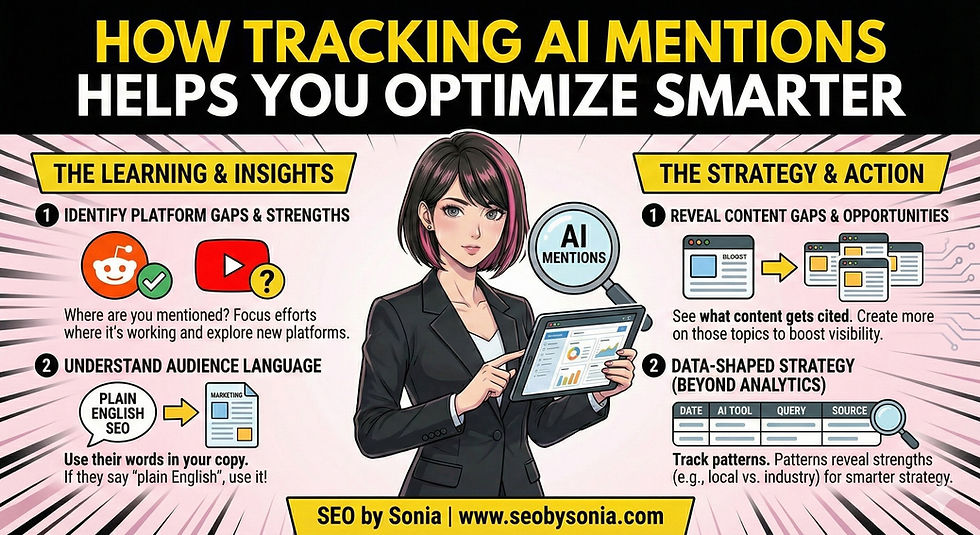
How Tracking AI Mentions Helps You Optimize Smarter
When you track where your brand is being mentioned, you learn where to focus your efforts. If you're getting lots of mentions from Reddit but none from industry blogs, maybe you should engage more on Reddit and try to get featured in more articles.
You can see what language people use when talking about you or recommending you. That language should inform your marketing copy and content. If people describe you as "the SEO person who explains things in plain English," lean into that. It's working.

Tracking helps you identify gaps. If you never see mentions on YouTube or podcasts, maybe that's a platform you should explore. If directory listings keep coming up, make sure your profiles are complete and optimized.
You learn which content gets cited most. I had a client whose blog post about career transitions kept getting referenced in AI responses. We created three more pieces of content on related topics, and her AI visibility increased significantly.
The Data Shapes Your Strategy
I keep a simple spreadsheet for clients tracking AI visibility. Date, AI tool, query used, whether they appeared, what was said about them, source cited if available. Over six months, clear patterns emerge.
Some clients show up consistently for local queries but never for industry-wide topics. That tells us to double down on local SEO and community engagement. Others show up for educational content but not services, so we need to create more service-focused content that's still valuable.
The tracking reveals your strengths and weaknesses in ways Google Analytics never could. You're not just seeing who visits your site. You're seeing who's recommending you to others and in what context.
Should You Invest in AI Search Optimization Services?
If your website is solid, you're creating good content, but you're still not being recommended by AI tools, you have a visibility gap. A discoverability and credibility problem.
You might need to optimize and do some technical things on your website, like adding schema markup that clearly tells search engines and AI tools what your content is about and who you are. Most small business websites have zero schema. That's a missed opportunity.
Directory citations matter more now. Not spam directories. Legitimate industry-specific directories, professional associations, and local business listings. These create credibility signals that AI tools recognize as validation of your expertise.
Brand mentions across platforms build the pattern AI needs to recommend you.
Guest posts, podcast interviews, being quoted in articles, and active participation in industry forums. Each mention is a data point telling AI "this person is relevant in this space."
FAQ content structured properly helps AI pull your answers for common questions. Clear questions, direct answers, natural language. This is the easiest way to start showing up in AI responses.
What I Do for Clients
I offer brand visibility audits where I check if and where clients are showing up in AI tools, what's working, and what's missing. We identify the gaps between their current visibility and where they should be.
AI search optimization as an ongoing SEO service includes content restructuring, schema implementation, strategic content creation, directory management, and monthly tracking of AI mentions and trends.
Some clients just need a one-time setup. Fix the technical issues, implement the schema, optimize existing content, and they're good to maintain it themselves. Others want ongoing support as AI search continues evolving.
The investment makes sense if you're already doing SEO but not seeing the AI visibility you expected. Or if you're in a competitive industry where being recommended by ChatGPT could be a significant competitive advantage.
FAQs: How to Track Brand Mentions in AI Search Results
How often should I check AI mentions?
Monthly is enough for most businesses. Set a recurring calendar reminder to test prompts in different AI tools and check your monitoring dashboards. If you're actively working on AI visibility, weekly checks can help you see impact faster and adjust strategy.
Do I need expensive tools to track this?
No. You can do basic tracking with free tools. Google Alerts, manual Reddit searches, GSC regex filters, and directly asking AI tools. Paid tools like BrandMentions make it easier and catch more, but you can start with free methods and upgrade if you see value.
About the Author & SEO Consultant
Sonia Urquilla is an SEO consultant who helps service providers get found without chasing clients online. She works with female coaches, consultants, service providers, and local service-based businesses that are tired of relying on referrals and social media alone.
Her work focuses on bridging the gap between how people search and how service providers talk about their work, helping websites turn visibility into leads. You can learn more about her approach here or schedule a strategy call.
Stop Guessing. Start Monitoring.
AI search is changing how people discover businesses. You can ignore it and hope for the best. Or you can actively monitor where you stand and work on improving your visibility.
I've seen clients go from zero AI mentions to showing up consistently in ChatGPT recommendations within six months. It's not luck. It's strategic optimization focused on the signals AI tools care about.
If you want to know where you currently stand and what's holding you back from AI visibility, I offer brand visibility audits. We'll check every major AI tool, analyze your current mentions, identify gaps, and create a plan to close them.
Whether you do this yourself or hire help, start tracking. You can't improve what you don't measure. And right now, most of your competitors aren't measuring this at all. That's your opportunity.
Key Takeaways
Directly prompt AI tools monthly to verify if your business is currently visible or invisible.
Set up brand alerts to catch unlinked mentions that feed AI credibility signals.
Use GSC regex filters to identify high-intent, conversational queries from potential clients.
Implement Product, HowTo, and VideoObject schema to make your expertise easily digestible for AI.
Create content that specifically answers the most common questions AI tools are asked in your industry.
How We Can Work Together:
Get a Free 10-Minute SEO Audit: Stop wondering why you aren't ranking. I’ll show you exactly what’s holding you back.
Done for you SEO services: Specialized strategy to turn your expertise into organic traffic.
SEO Copywriting Services: Let me handle the research and content plan for you with high-converting, optimized copy.
Book a Strategy Call: Let’s map out your specific 12-month plan together.
Your ideal clients are searching for solutions right now. Make sure they find you.


Excelente artículo, Sonia, encontré este blog por Reddit y lo tenia sin leer. Me encanta cómo desglosas las fuentes reales que las IA están consumiendo (Reddit, podcasts, directorios) y el enfoque práctico de preguntar directamente a los modelos. Esa combinación de monitoreo de menciones + GSC con regex es la base de cualquier estrategia GEO sólida.
Como complemento desde la perspectiva de medición un poco mas técnico en GA4, añadiría que también es posible capturar el tráfico de clics reales que esas menciones generan. Con un grupo de canales personalizado (regex case‑insensitive, orden Tráfico IA → Organic Search → Referral, y validación con la dimensión Medium), podemos aislar el ~29% del tráfico de IA que sí pasa referrer. Y ese…